Photo: Unsplash
Most babies start moving — rolling, scooting, then crawling — well before parents expect, which is why baby-proofing tends to work best done in advance rather than in a rush. A room-by-room pass covers more ground than trying to remember everything at once, and it's worth revisiting regularly rather than treating it as a single weekend project.
When to start baby-proofing
A reasonable rule of thumb is to start around four to six months, before mobility really picks up, since it's easier to fix hazards while a baby is still stationary than to chase a moving target. Some basics, like securing furniture and covering outlets, are worth doing even earlier, ideally before the baby even comes home from the hospital.
Kitchen
- Install cabinet and drawer latches, especially near cleaning supplies.
- Move sharp objects and small appliances out of reach.
- Use back burners when cooking and turn pot handles inward.
- Store trash and recycling behind a latched door if possible.
- Unplug and put away small appliances after use.
Bathroom
- Store medications, vitamins, and cleaning products in a locked cabinet.
- Add a toilet lock if your baby is starting to pull up.
- Set your water heater to 120°F (49°C) or lower to prevent scalding.
- Use a non-slip mat in the tub.
- Never leave a baby unattended near any amount of standing water.
Living room and common areas
- Anchor bookcases, dressers, and TVs to the wall.
- Cover electrical outlets not in regular use.
- Add corner guards to sharp furniture edges.
- Install baby gates at the top and bottom of stairs.
- Check for small, swallowable objects at floor level (coins, batteries, small toy parts).
- Tie or shorten window blind cords, or switch to cordless blinds.
Nursery
Keep the crib free of pillows, blankets, and stuffed animals for infants, following current safe-sleep guidance. Make sure the crib is set to the lowest mattress position once your baby can sit or pull up, and check that no cords (from blinds, monitors, or lamps) are within reach of the crib. See our newborn sleep safety guide for a fuller rundown of current safe-sleep recommendations.
Bedrooms and stairs
- Install gates at both the top and bottom of any staircase, using a hardware-mounted gate at the top specifically.
- Secure window blind cords well out of reach, or replace blinds with a cordless version.
- Move any climbable furniture (chairs, low dressers) away from windows.
- Check smoke and carbon monoxide detectors are working in or near sleeping areas.
- Keep small decorative items, jewelry, and coins off low nightstands and dressers.
Plants, pets, and other household hazards
A few hazards fall outside the usual room-by-room checklist entirely. Several common houseplants are mildly to seriously toxic if chewed or eaten, and it's worth checking each plant in your home against a poison control resource rather than assuming decorative plants are automatically safe. Pet food and water bowls sit at exactly the height a crawling baby explores, and pet food itself can be a choking hazard. If you have a dog or cat, it's also worth giving your pet a way to retreat from a curious baby, a baby gate, a separate room, or a raised perch, since even a generally gentle pet can react unpredictably to sudden grabbing or poking.
Outdoor and pool safety
If your home has a yard, deck, or pool, outdoor hazards deserve the same systematic attention as the inside of the house. Check that any pool or hot tub has a self-latching, self-closing gate that meets local safety codes, and never treat a pool cover alone as sufficient supervision. Look for gaps in deck railings wide enough for a small body to slip through, check that any outdoor furniture won't tip if climbed on, and store gardening chemicals and tools in a locked shed or high shelf rather than an easily accessible cabinet. Standing water, in a bucket, an inflatable pool, or even a birdbath, is worth emptying when not in use, since young children can drown in a surprisingly small amount of water and surprisingly quickly.
Baby-proofing when visiting other homes
A home that's fully baby-proofed doesn't help much at a grandparent's house, a friend's place, or a vacation rental that hasn't been checked at all, since none of that preparation travels with you automatically. A portable version of your safety routine, a few outlet covers, a portable gate, a travel-sized cabinet lock kit, packed in the diaper bag for visits, covers the most common gaps quickly. It's also worth doing a quick walkthrough of any new space at a baby's-eye level before letting them loose to explore, the same way you would at home, since unfamiliar environments often carry hazards a host hasn't thought to consider from a baby's perspective.
Getting down to a baby's-eye view
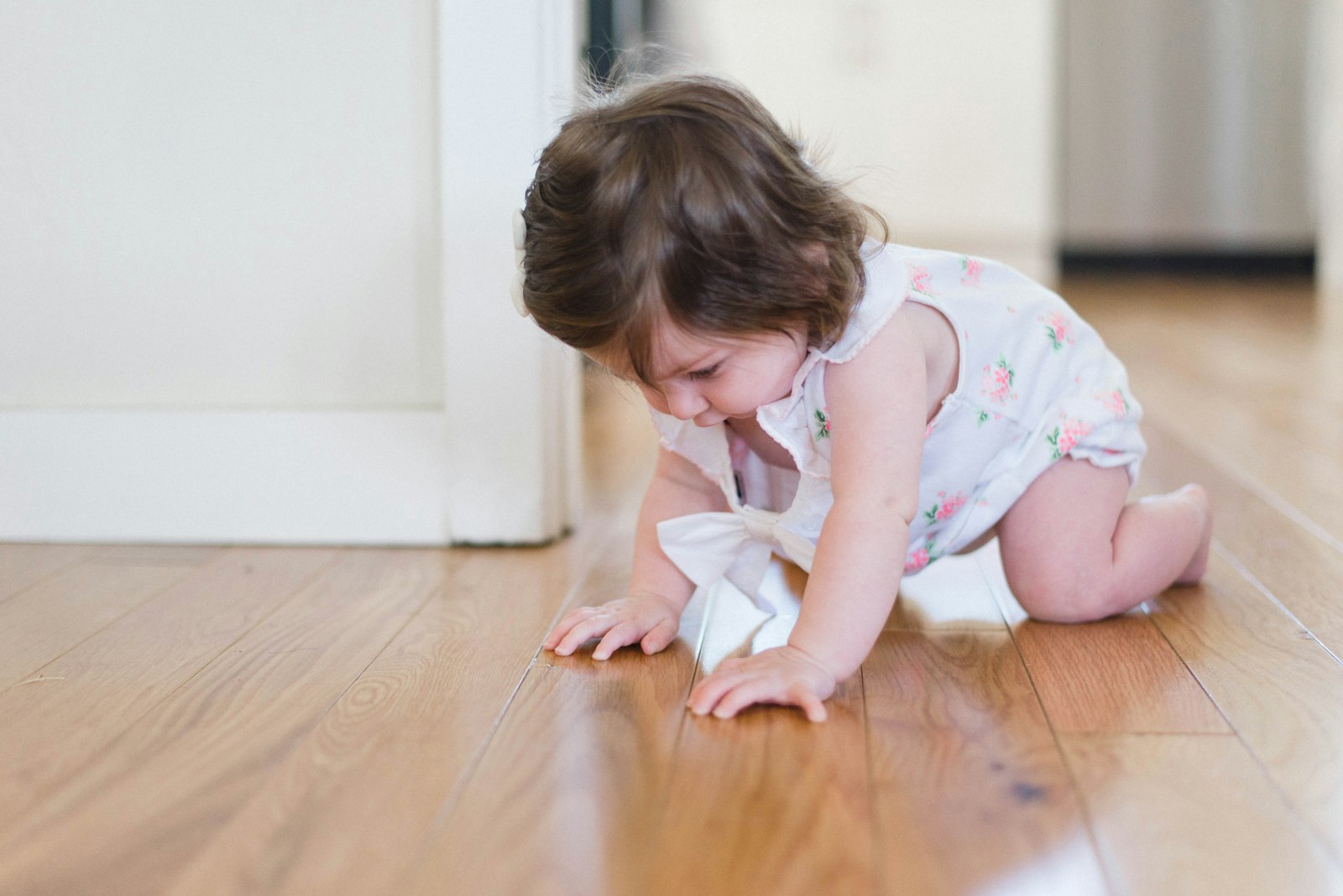
One of the most effective baby-proofing tricks is simply getting down on the floor in each room and looking around from a crawling baby's height — hazards that are invisible from standing height (a dangling cord, a low outlet, a sharp table edge) often become obvious immediately once you're actually down there looking.
Furniture tip-over: an underestimated risk
Furniture and TV tip-overs are a leading cause of serious injury for young children, and the mechanism is often surprising to parents — a toddler doesn't need to climb far up a dresser or bookcase for it to become top-heavy enough to fall, especially once a drawer is pulled open partway and used as an impromptu step. Anti-tip anchor kits (a strap or bracket connecting furniture to a wall stud) are inexpensive and take only a few minutes to install per item, but they're one of the most commonly skipped safety steps simply because tip-over risk isn't as visible or intuitive as an exposed outlet or a sharp corner. Any furniture a baby could pull up on, climb, or use to reach a TV — dressers, bookcases, changing tables, TV stands — is worth anchoring well before a baby is pulling to stand, since mobility milestones often arrive earlier than a specific "baby-proof by this date" plan accounts for.
Garage, laundry, and other overlooked spaces
Baby-proofing checklists often focus heavily on the kitchen, bathroom, and living areas and skip spaces that get less daily traffic but still carry real hazards for a curious, mobile child. A garage may store chemicals, tools, or a car with a door that seems tempting to a toddler exploring on their own; laundry rooms often have detergent pods — brightly colored and easy for a young child to mistake for candy — along with hot appliances at floor level. Locking or gating off these lower-traffic spaces, and storing detergent pods and other chemicals up high in a latched cabinet rather than at floor or countertop level, closes a gap that a room-by-room checklist focused only on the main living areas can miss.
Baby-proofing that keeps evolving with mobility
What counts as "baby-proofed" isn't a one-time project — a home that's safe for a five-month-old who can't yet move isn't necessarily safe for a ten-month-old who's cruising along furniture, and won't be safe at all for a toddler who can climb stairs or open doors. It's worth doing a fresh safety pass at each major mobility milestone: once a baby starts rolling, once they're crawling, once they pull to stand, and again once they're walking and starting to climb. Cabinet latches that stopped a crawler often don't stop a determined toddler who's learned to pull, twist, or lift them, and door handle covers may need an upgrade once a child can reach and manipulate a standard doorknob.
Products that create a false sense of security
Not every baby-proofing product performs as well as its packaging suggests, and it's worth being a little skeptical of items marketed as a complete fix. Outlet covers that simply plug into an outlet can be a choking hazard themselves if a child pulls them out, and sliding plate covers that stay attached are generally considered a safer choice. Pressure-mounted baby gates are fine for doorways between rooms but are not considered safe at the top of stairs, where a hardware-mounted gate that bolts into the wall is the standard recommendation, since a pressure gate can be pushed loose by a leaning or climbing child. Reading a product's specific intended use, rather than assuming any "baby safety" label covers every situation, avoids gaps that a general checklist alone won't catch.
A simple room-by-room walkthrough routine
Rather than trying to baby-proof an entire house in one exhausting weekend, many parents find it easier to tackle one room at a time over a couple of weeks, starting with wherever the baby spends the most time. A practical order is: nursery and any room used for naps first, since that's where a baby sleeps unsupervised; then the main living area, since that's where a baby will spend the most awake time; then the kitchen and bathroom, since those carry the highest concentration of chemical and burn hazards; and finally bedrooms, stairs, and less-visited spaces like the garage or laundry room. Spreading the work out also makes it easier to actually test each fix, does the cabinet latch really hold, does the gate really stay put, rather than rushing through a checklist without verifying anything actually works.
Common baby-proofing mistakes
- Relying on a product's packaging claims without testing it yourself; not every latch, cover, or gate performs as advertised once installed.
- Baby-proofing once and assuming it's done, rather than reassessing at each new mobility milestone.
- Overlooking low-traffic spaces like the garage, laundry room, or a home office where chemicals or small objects tend to accumulate.
- Using a pressure-mounted gate at the top of a staircase instead of a hardware-mounted one.
- Assuming a plugged-in outlet cover is safer than a sliding plate cover, when the reverse is often true.
When to call poison control or a doctor
Even with careful baby-proofing, accidents happen, and knowing what to do in the moment matters as much as prevention. If your child swallows something you suspect might be toxic, medication, a cleaning product, a battery, or a plant, contact your local poison control center immediately rather than waiting to see if symptoms appear, and keep the number saved somewhere accessible, on your phone and posted visibly at home. For a fall, a bump, or anything involving visible injury or a change in behavior, such as unusual drowsiness or repeated vomiting, contact your pediatrician or seek emergency care rather than waiting it out. Organizations such as HealthyChildren.org from the American Academy of Pediatrics offer up-to-date guidance on home safety and what to do in common emergencies.
Frequently asked questions
What age should I start baby-proofing?
Around four to six months is a common starting point, before crawling typically begins, though some basics like furniture anchoring and outlet covers are worth doing even earlier since they take little effort.
Do I really need to anchor furniture if my baby is not walking yet?
Yes — tip-over risk increases as soon as a baby can pull up or climb, which can happen earlier than expected. Anchoring furniture in advance is safer than trying to catch up once a baby is already mobile.
What temperature should my water heater be set to?
A commonly recommended maximum is 120°F (49°C), which reduces the risk of scald injuries while still providing comfortably warm water for baths and everyday use.
How often should I recheck a room once it's baby-proofed?
Do a fresh pass at each major mobility milestone, rolling, crawling, pulling to stand, walking, and climbing, since a fix that worked for a stationary baby often isn't enough once they can move, reach higher, or manipulate a latch.
Is baby-proofing at a grandparent's house really necessary?
Yes, especially if your child spends regular time there. A quick portable kit, gates, outlet covers, cabinet locks, along with a baby's-eye-level walkthrough of the space, covers most common hazards without requiring a full renovation of someone else's home.