Photo: Pexels
To trim baby nails safely, do it after a bath or while your baby is asleep or calm, in good light. Press the finger pad down and away from the nail, cut straight across with baby clippers or rounded-tip scissors, and smooth any corners with a soft file. In the first weeks, filing alone is the gentlest option.
Why newborn nails are sharp and grow so fast
Many babies arrive with nails that look surprisingly long, and they seem to be sharp again a few days after you deal with them. Both things are normal. A baby's nails are thin and flexible, which makes them bend and curl into a tiny blade, and they keep growing steadily from the start. The American Academy of Pediatrics (AAP) notes that newborn nails will likely need trimming or filing at least once a week.
The real problem is that your baby has almost no control over those hands yet. Newborns flail, startle, and rub their faces, so a sharp corner turns into a scratch on the cheek, the eyelid, or the nose. If you have ever seen a baby wake up with a thin red line across the face, you have met the reason this task matters. Scratches usually heal quickly, but they are upsetting to see, and a scratch near the eye is worth avoiding altogether.
If you are searching for why your baby keeps scratching their own face, the short answer is nails plus a startle reflex. Keeping nails short and smooth solves most of it. The rest of this guide covers how to do that without nicking the skin.
When to cut newborn nails
You will hear two different pieces of advice, and both come from caring people. Some families were told to wait until a baby is a few weeks or even months old. Many pediatric sources say it is fine to trim from birth as long as you are careful. The practical middle path works well for most households.
- The first days to first weeks: the nails are very soft and often stuck close to the skin. Filing with a soft emery board is the easiest and safest way to take the edge off. A parent can sometimes lift off a loose, soft nail tip with a fingertip, but only when it is already coming away on its own. Do not pull or tug.
- Once the nail has a visible free edge: you can switch to baby clippers or rounded scissors when you feel confident. Use the file to finish.
- Whenever scratches appear: that is your cue, whatever the calendar says.
So the honest answer to when to cut newborn nails is this: when there is enough nail to hold safely and your baby is scratching or about to. There is no magic birthday. If you feel nervous, file for the first few weeks and trim later.
Baby nail clippers vs file: which should you use?
Each tool has a place. The AAP says that clippers and scissors trim in a more controlled way than biting or peeling, and that a nail file alone can keep things under control. Here is how the options compare in real life.
- Soft emery board or baby file. The safest choice for newborns because it cannot cut skin. It is slower, and you need to file in one direction so the nail does not catch. Glass files work too and give a smooth edge, but check that your baby cannot get a grip on it, and keep it clean.
- Baby nail clippers with a guard. These have a small blade opening, which gives you a good view of the nail, and a guard that makes it harder to catch skin. They are quick once you have practice. Choose a pair sized for a baby, not a loose adult pair.
- Baby scissors with rounded tips. Many parents like these because they follow the curve of the nail and you can see exactly where the blade is. The rounded tip means a sudden wiggle is less likely to puncture skin.
- Electric baby nail trimmers. Some families like them because they sand the nail down gently. They are optional. Use them on the lowest setting and read the instructions before you start.
Avoid adult clippers. They are bigger, the jaws are stiffer, and the blade is harder to control around a tiny fingertip. You will also have a harder time seeing the nail, because the clipper covers more of it.
If you are choosing between baby nail clippers and a file, start with the file for the first weeks and add clippers or scissors when you are ready. Plenty of parents keep both and use whichever suits the moment. A file is also the best way to remove the small sharp corner that clippers sometimes leave behind.
What to set up before you start
- Your tool of choice: baby clippers with a guard, rounded-tip baby scissors, or a soft file.
- A soft file or emery board to finish edges, even if you are clipping.
- Clean gauze or a soft cloth within reach, just in case of a nick.
- Good light. A window, a lamp over your shoulder, or the light on your phone held by a partner.
- A comfortable spot, such as a chair where your forearm can rest on a pillow or a table.
- A distraction ready if your baby is awake: a soft song, a small toy, or a partner.
- Clean hands for you, and a quick wipe of the tool with soap and water or an alcohol wipe, then let it dry.
The best time to trim baby nails
Timing makes more difference than technique. A few moments to choose from, and what each one offers:
- After a bath. Warm water softens the nails, so they are easier to cut and less likely to split. The NHS also suggests trimming nails after a bath or shower. Our newborn first bath guide covers the bath itself, and nail care slots in naturally afterward.
- While your baby is asleep. The AAP suggests trimming or filing when your baby is asleep, because the hands are less of a moving target. Pick a deep sleep, such as the start of a long nap, and work slowly.
- After a feed, when baby is full and calm. A fed baby is often relaxed and drowsy. Some babies fall asleep mid-feed, which is the perfect time to take one hand and quietly file.
Avoid trimming when your baby is hungry, overtired, or fussy. A thrashing hand and a clipper do not mix, and there is no deadline. If today is not the day, try again tonight or tomorrow.
How to trim baby fingernails, step by step
Take it one finger at a time. You do not have to finish all ten in one sitting.
- Get settled. Sit comfortably with good light. Hold your baby in your lap, supported against your body, or lay them down on a changing mat if that feels steadier. If they are asleep, leave them where they are and sit close.
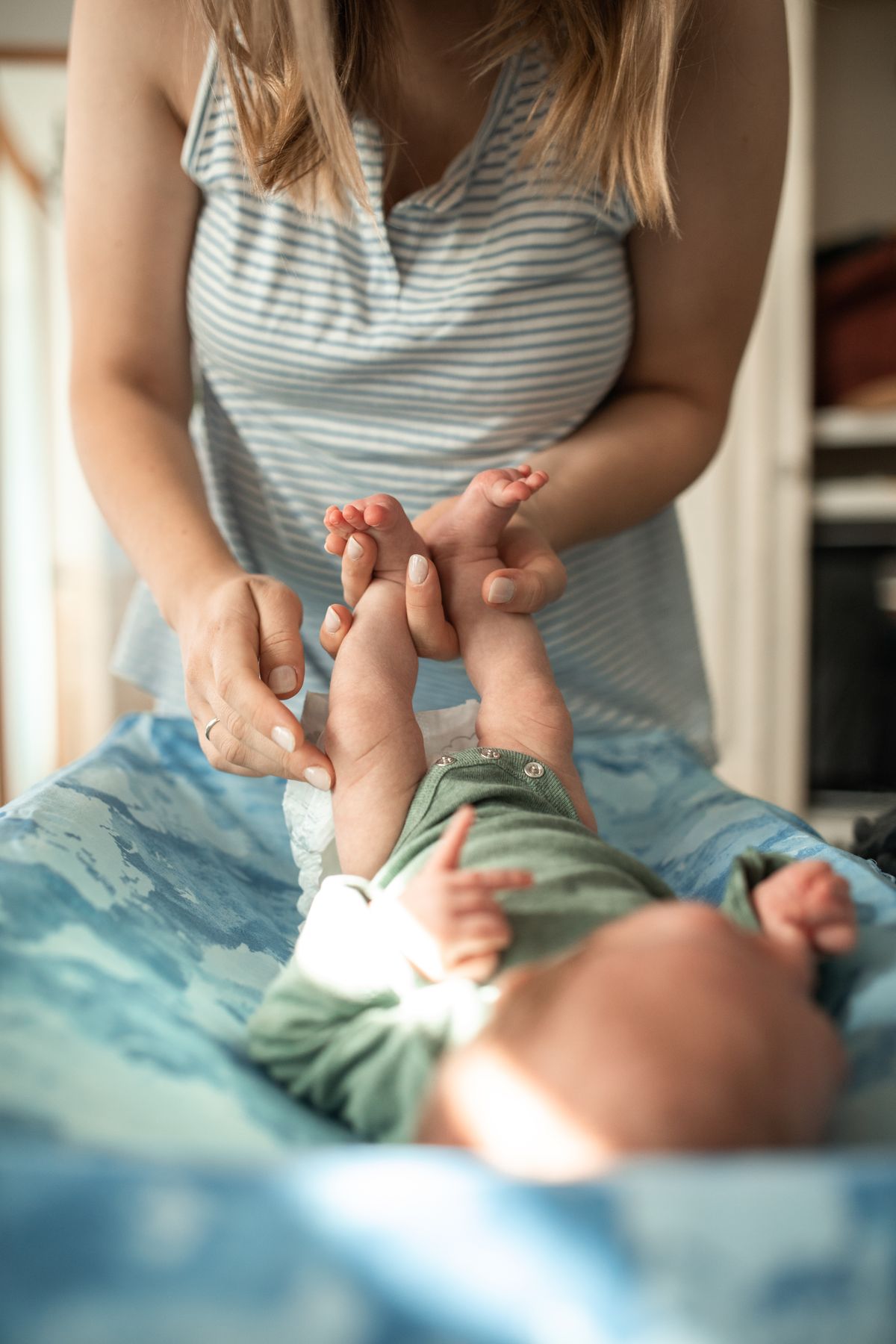
- Hold one hand and one finger. Gently take your baby's hand in yours. Separate a single finger and hold it between your thumb and index finger so the nail is facing you.
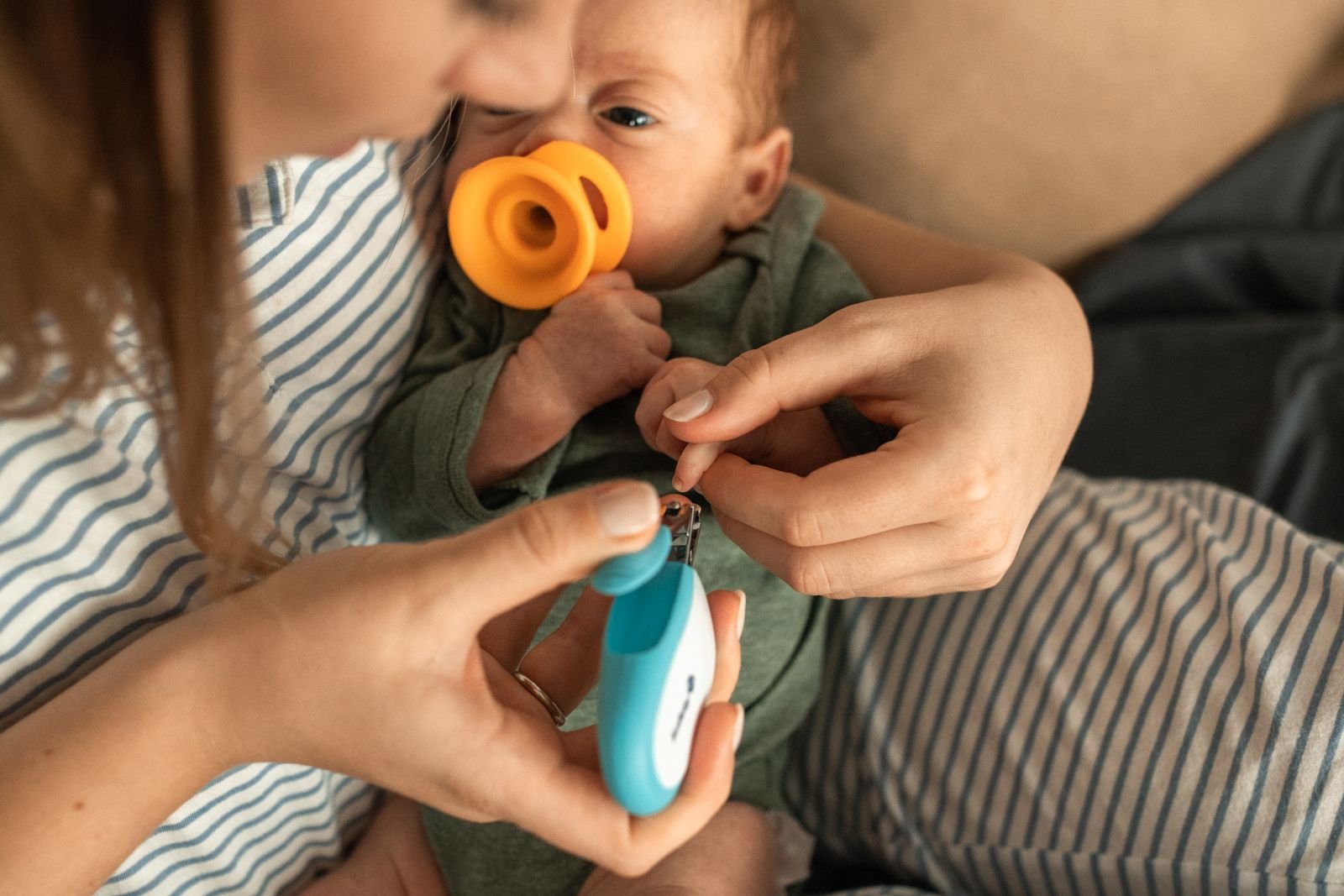
- Press the finger pad down and away. Use your thumb to push the soft skin at the tip of the finger down and away from the nail. This is the AAP's tip, and it is the single best way to avoid catching skin. It exposes the full free edge of the nail and moves the fingertip out of the blade's path.
- Cut or file only the white tip. You want to remove the white free edge and leave a little of it. Never cut into the pink part of the nail bed.
- Cut straight across, then follow the curve gently. A single straight snip is safest, because it avoids digging into the side corners. If you want a softer shape, take off the sharpest corners with tiny snips or, better, the file. The NHS advice for nails in general is to trim straight across and not down the edges.
- Make small snips. Several tiny cuts beat one big one. If the nail is wide, work from one side to the other.
- File the edge smooth. Run a soft emery board across the tip in one direction until no rough point is left. Run your own fingertip over it. If it catches on your skin, it can catch on your baby's face.
- Check, then move to the next finger. Look at the whole fingertip. There should be no blood, no pale or pinched skin, and no leftover scrap of nail. Repeat for each finger, taking breaks whenever your baby asks.
- Keep the clippings tidy. Small nail pieces can end up in a baby's mouth or in a bed. Brush them into a tissue and throw them away.
Filing: the safest option in the first weeks
If you only do one thing from this guide, make it this. Filing cannot nick the skin, and it is nearly always enough in the first weeks while nails are tiny and soft. It also suits parents who are anxious about clipping, which is nearly everyone at first.
- Hold the finger and press the pad down, just as you would for clipping.
- Using a soft, fine file, stroke in one direction from the sides toward the center of the nail tip. A back-and-forth sawing motion can tug at the nail.
- Keep the strokes light. You are rounding off the edge, not grinding down the nail.
- Stop when the tip feels smooth against your own fingertip.
The only downside is time. A file takes longer than a clipper, and it needs to be done weekly. A baby who is asleep, or half asleep after a feed, is the best candidate.
How to trim baby toenails
Toenails are a different job. They grow more slowly, they are small and curved, and they are less likely to scratch anyone. That means you can relax about them, and you do not need to trim as often.
- Cut straight across and leave them a little longer. The NHS advises trimming straight across the top and not down the edges, which helps avoid an ingrown toenail. Do not round the corners or cut them very short. Cutting too short can let the nail grow into the skin.
- Use the same pad trick. Press the skin at the tip of the toe down and away from the nail.
- Use clippers or a file, whichever feels easier. Many parents find the file easier on toes because the nails are so small.
- Do not worry if they look thick or ridged. Baby toenails often look different from fingernails. Thick and yellow nails are covered in a separate section below.
A realistic example: the first trim at 10 days old
Here is how this often goes in practice. Imagine a 10-day-old who woke up with a scratch on the cheek. You pick up the clippers at 3 p.m., baby wriggles, you hold your breath, and you give up. Sound familiar?
A better plan: wait until the evening, after the bath and the last feed of the day. Your baby is warm, full, and drowsy. Dim the big light, turn on a lamp over your shoulder, and settle into a chair with a pillow under your forearm. Take the left hand first. Press the finger pad down, use the file for a few gentle strokes, and move on. If your baby starts to stir, stop, rock, and try the next finger once they settle. You might do only three fingers on the first night, and that is a good night. By day three, all ten are done. By week three, you are doing it in under five minutes.
The lesson is that a good first trim is slow, a little boring, and quiet. The pressure to finish is what causes the nicks.
The two-person technique
If you are nervous, a second adult makes a big difference. One person holds and soothes the baby, and the other does the nails.
- The holder keeps the baby supported against their chest or in the crook of their arm, with one hand free to steady the baby's wrist.
- The trimmer sits facing the baby, holds a single finger, and works with both hands.
- The holder can also sing, rock, or offer a pacifier or a feed to keep baby calm.
- Agree on a stop word. If either adult feels uneasy, you pause, with no discussion needed.
This also helps if you are the parent who sat through a long labor and are running on very little sleep. Your partner holding the light and the baby is a gift.
If your baby is squirmy: tips for older babies and toddlers
A baby of 6 or 9 months is a different task from a sleepy newborn. They are strong, curious, and will grab the clippers. Toddlers add opinions. Try these:
- Make it a routine. Same day, same spot, same song. Babies relax when they know what is coming. Sunday after the bath works for many families.
- Use a distraction. A short song, a favorite book, a safe toy for the other hand, or a video for a toddler. Save the distraction for nail time so it stays interesting.
- Try nap time. If your child sleeps deeply, a trim a few minutes after they drop off often goes smoothly.
- Work on a lap, facing outward. A baby sitting on your lap, facing away, can watch something while you hold each hand from behind.
- Do one hand at a time. Five fingers today and five tomorrow is a perfectly good plan.
- Let a toddler help. Let them hold the file, try it on a stuffed animal, or choose the song. Giving a small job reduces the fight.
- Switch to the file. A moving target is a good reason to use a file in place of clippers.
If every attempt ends in tears, take a break for a day or two. Nails are low stakes, and a calm relationship with the routine matters more than a perfect manicure.
What to do if you nick the skin
It happens to almost every parent at some point. Your baby cries, you feel awful, and there is a tiny dot of blood. Stay calm. A small nick is not an emergency.
- Stop and put the tool down. Comfort your baby for a moment.
- Apply gentle pressure. Use a clean piece of gauze or a clean soft cloth and press lightly on the spot for a few minutes. Do not keep lifting it to look.
- Let it stop on its own. Small nicks usually stop bleeding quickly with pressure.
- Keep it clean and dry. You usually do not need ointment unless your doctor tells you to use one. A bandage is often not needed and can be a choking risk on a tiny finger if it comes off.
- Watch it for the next few days. Look for redness that spreads, swelling, warmth, or pus, and call your doctor if you see them.
If the bleeding does not stop after several minutes of steady pressure, or if you cut deeper than a small nick, call your pediatrician. Our guide on when to call the pediatrician has more on what is urgent and what can wait.
Mittens: optional, and not a substitute for trimming
Baby mittens are everywhere, and they are fine as a short-term tool. The AAP notes that many parents cover newborns' hands with mittens or socks to prevent scratches. It also suggests that as your baby develops, they should have plenty of time to explore freely with their hands, and that if scratches continue to be a problem, you can limit mitten time to when your baby is asleep.
A few practical points:
- Mittens are optional. Short, smooth nails are the real fix.
- Choose a loose, soft pair. They should not leave a mark on the wrist.
- Check the inside of every mitten for loose threads or fraying. A stray thread can wrap around a finger or toe and cut off the circulation. This is called a hair or thread tourniquet, and it is a reason to inspect mittens, socks, and sleepers regularly.
- If a finger or toe looks red, swollen, or unusually pale, and you cannot find the cause, look for a thread or hair wrapped around it and call your doctor right away if you cannot remove it easily.
- Do not leave mittens on during awake time as a replacement for care. Babies use their hands to learn about the world, and hand exploration is part of development.
- Never tie mittens on with string or ribbon.
If your baby has itchy, irritated skin or eczema and scratches because of it, short nails matter even more. Our baby eczema and skin care guide explains how to manage the skin itself, and your pediatrician may suggest cotton mittens at night as part of a plan.
Premature babies and very small newborns
Babies born early often have nails that are very thin, soft, and short, and their skin is more fragile. The gentle approach matters even more here. If your baby was in a neonatal unit, ask the nurses to show you how they do it, and ask whether they recommend filing only for now. Do not start clipping at home until someone with experience has watched you do one finger. If your baby is home and you are not sure what to do, ask your pediatrician at the next visit.
How often to trim baby nails
This varies from baby to baby, and nails seem to grow faster in some months than others. As a rough guide:
- Fingernails: about once a week, or when you see a free edge long enough to catch. The AAP says newborns will likely need trimming or filing at least once a week.
- Toenails: about every 2 to 3 weeks, or when they start to look long or catch on socks.
- Check in between: a quick file of any rough corner takes seconds and can save a scratch.
A good habit is to attach it to something you already do, such as the weekly bath night or a Sunday evening.
Ingrown nails and nail infections
Two problems are worth knowing about: the nail growing into the skin, and infection around the nail.
An ingrown nail happens when the edge of the nail pushes into the skin beside it. It is more common on toes, and cutting nails too short or rounding the corners makes it more likely. You may see a red, tender edge on one side of the nail. Cutting straight across and leaving toenails a little longer helps to prevent it.
Infection of the skin around a nail is called paronychia. The NHS describes the signs as skin around the nail that has become sore, red, swollen, and warm, and says it can be a sign of infection or an ingrown toenail. In a baby you might also see pus. It can follow a nick, a torn hangnail, or the habit of biting or peeling nails. The AAP warns that biting or peeling a newborn's nails can lead to infection.
Call your doctor if you see any of these around a nail:
- Redness that is spreading or getting worse
- Swelling or a shiny, tight look to the skin
- Warmth when you touch it
- Pus or a yellow or white pocket
- Your baby cries or pulls away when you touch the finger or toe
- A fever alongside any of the above
Do not squeeze it, pick at it, or try to drain it yourself.
Thick, yellow, or oddly shaped nails
Baby nails vary a lot. Fingernails are usually thin and flexible, and toenails are often thicker and look a little ridged. A slight yellow tint can show up from the skin's natural color or from a bit of staining. Ridges, small white flecks, and a bit of peeling at the tip are common and usually harmless.
What deserves a call to your pediatrician: nails that are very thick and crumbly, nails that change color or shape without a clear reason, a nail that lifts off the nail bed, or any nail that looks different from the others and keeps changing. The NHS says to see a doctor if a nail has changed shape, changed color, or fallen off and you do not know why. You can also ask about it at your baby's routine checkup, so you do not have to wonder.
Fingernails vs toenails at a glance
- Growth: fingernails grow faster, so they need attention about weekly. Toenails grow more slowly.
- Shape: fingernails can have a slightly curved edge. Toenails should stay straight across.
- Length: trim fingernails short enough to avoid scratches. Leave toenails a bit longer.
- Risk: long fingernails mean scratches. Short, rounded toenails mean ingrown nails.
- Tool: clippers, scissors, or a file work for both. A file is often easiest on toes.
Common mistakes
- Using adult clippers. They are harder to control and hide the nail.
- Cutting too short. Aim to take off the white tip only. Cutting into the pink skin causes nicks and ingrown nails.
- Not pressing the finger pad down. That small push is the main reason skin gets caught.
- Rounding toenails. Cut straight across and leave them a little long.
- Trimming a fussy, hungry baby. Wait for a better moment.
- Leaving sharp corners. Finish with a file every time.
- Biting or peeling nails. It is a quick fix that can lead to infection and torn skin.
- Working in poor light. Good light is a safety tool.
- Skipping the mitten check. Loose threads inside mittens and socks can wrap a finger or toe.
- Trying to do all ten at once. A little at a time is fine.
Myths vs. facts
- Myth: you should never cut a newborn's nails before a certain age. Fact: there is no fixed age. Many pediatric sources say trimming is fine from birth with care, and filing is a gentle way to start.
- Myth: biting off your baby's nails is safer than clippers. Fact: the AAP says biting or peeling can potentially lead to infection, and clippers, scissors, or a file give you better control.
- Myth: mittens solve the problem. Fact: they cover it up for a while. Short, smooth nails do the real work, and babies need free hands to explore.
- Myth: baby nails are too soft to scratch. Fact: thin nails can still curl into a sharp edge that scratches the face.
- Myth: a nick means you have hurt your baby badly. Fact: small nicks are common and stop bleeding with gentle pressure.
- Myth: toenails need cutting as often as fingernails. Fact: they grow more slowly, and cutting them too short can cause ingrown nails.
When to call the doctor
Most nail care is simple, but a few things need a medical eye. Call your pediatrician if:
- Bleeding does not stop after several minutes of gentle, steady pressure.
- The skin around a nail is red, swollen, warm, or has pus, or the redness is spreading.
- Your baby has a fever along with a sore finger or toe.
- A finger or toe looks swollen, pale, or purple, and you think a thread or hair may be wrapped around it.
- A nail looks very thick, crumbly, or is lifting off the nail bed, or its color or shape has changed and you do not know why.
- You have a cut or scratch near the eye that does not look right.
- Your baby was born early or has a skin or circulation condition, and you want advice on how to trim.
For general reading from two trusted sources, the AAP has a short piece called Nailing It: How to Trim Your Baby's Fingernails, and the NHS has a page on nail problems with advice on trimming and signs of infection. If you are still working out the rest of your newborn routine, our guides to umbilical cord care and how to swaddle a baby cover two more tasks that feel scary at first and get easy with practice.
Frequently asked questions
When can I start trimming my newborn's nails?
Many pediatric sources say you can trim from birth if you are careful. In the first weeks the nails are soft, so filing with a soft emery board is the gentlest start. Move to baby clippers or rounded scissors when there is a visible free edge and you feel confident.
Are baby nail clippers or a file better?
A file is the safest choice for the first weeks because it cannot cut skin. Baby clippers with a guard or rounded-tip scissors are faster once you have practice. Many parents use clippers for the bulk and a file to smooth the edges.
What should I do if I cut my baby's skin while trimming nails?
Stay calm and press a clean piece of gauze or a clean soft cloth on the spot for a few minutes. Small nicks usually stop bleeding quickly. You normally do not need ointment unless your doctor advises it. Watch for spreading redness, swelling, warmth, or pus, and call your doctor if you see any.
How often should I trim baby nails?
Fingernails usually need trimming or filing about once a week, and toenails about every 2 to 3 weeks. It varies from baby to baby, so check the nails often and file any sharp corner as soon as you notice it.
Do I need to put mittens on my baby to stop face scratching?
No. Mittens are optional and should be loose, with no loose threads inside. Short, smooth nails are the real fix. Babies also need time with free hands to explore, so many parents limit mittens to sleep time if scratches continue.