Photo: Pexels
Eating while breastfeeding mostly means eating regular, varied meals and drinking when you are thirsty. The CDC cites an extra 330 to 400 calories a day for well-nourished mothers, though needs vary. Keep caffeine moderate, plan alcohol around feeds, choose low-mercury fish, and call your provider if your appetite or mood drops.
How many extra calories breastfeeding uses
Making milk takes energy, so most breastfeeding mothers need to eat more than they did before pregnancy. The CDC says an additional 330 to 400 kilocalories a day is recommended for well-nourished breastfeeding mothers, compared with what they ate before pregnancy. That is a rough planning figure, not a target to count.
The same CDC page is clear that the real number varies. It depends on your age, your body mass index, how active you are, and whether you breastfeed exclusively or also give formula. A mother nursing around the clock needs more than one who nurses morning and night and pumps at work. Someone walking two miles a day with a stroller needs more than someone recovering from a cesarean who mostly rests on the couch.
So if you ask how many calories you need while breastfeeding, the honest answer is a range plus your own hunger. Think of the extra as one generous snack or a bigger breakfast, spread across the day. If you want a personal number, ask your provider or a registered dietitian, who can account for your weight, activity, and any health conditions.
Hunger and thirst cues: let your body lead
Many new mothers notice a sudden, sharp hunger or thirst while the baby is nursing. That is common, and it is a sign your body is doing extra work. Eat when you are hungry. Do not wait until the baby sleeps, because that moment may not come until the evening.
For fluids, drink to thirst. The NHS suggests keeping a drink beside you when you settle down to breastfeed, and many people find a glass of water at each feed is an easy habit to build. It is a habit, not a rule. You do not need to force down a set number of liters, and pale yellow urine and a comfortable mouth are better guides than a gadget. Water, milk, and diluted juice all count, and so do soup and tea within your caffeine limit.
Two warning notes. If you feel dizzy, shaky, or faint between meals, you are probably going too long without food. And if you notice you are never hungry at all, that is worth mentioning to your provider, which we cover near the end.
The nutrients that matter most
You do not need a special diet. The NHS says exactly that, and the CDC says women generally do not need to avoid specific foods while breastfeeding. What helps is variety, so your own stores are not drained to make milk. These are the nutrients worth a little attention:
- Protein from eggs, fish, poultry, beans, lentils, tofu, yogurt, and nuts supports recovery after birth. Aim for some at every meal.
- Iron from red meat, poultry, fish, beans, lentils, and fortified cereals helps rebuild stores after birth. Plant iron is absorbed less easily, as the CDC notes, so pair it with a vitamin C food such as citrus, peppers, or tomatoes.
- Calcium and vitamin D come from dairy or fortified dairy alternatives, canned fish with soft bones, and tofu set with calcium. The NHS suggests considering a daily 10 microgram vitamin D supplement in autumn and winter. Ask your provider what is right where you live.
- Choline and iodine are two nutrients whose recommended intake rises while breastfeeding. The CDC lists 550 milligrams of choline and 290 micrograms of iodine a day, and points to dairy, eggs, meat, and low-mercury seafood as sources.
- Omega-3 fats (DHA) come from low-mercury fish such as salmon. More on fish safety below.
- Folate and vitamin A come from legumes, dark leafy greens, and orange and red vegetables, according to the CDC.
- Fiber and fluids help with the constipation many people have after birth, as the NHS points out.
The CDC says that because needs for some nutrients rise, diet alone may not be enough, and breastfeeding mothers may benefit from a multivitamin. Many providers suggest continuing your prenatal vitamin while you nurse. Ask yours, since the right choice depends on your diet and health.
Fish, caffeine, and alcohol: what to limit
These three come up most often, so here is what the guidance actually says.
Fish. Fish is a good source of protein and DHA, but most fish contain some mercury, which can pass into breast milk. The CDC tells breastfeeding mothers to follow the FDA and EPA advice: choose from the Best Choices and Good Choices categories, and avoid the Choices to Avoid fish. For adults a serving is 4 ounces before cooking. The CDC suggests two to three servings (8 to 12 ounces) a week if all the fish are Best Choices, and one serving if the fish is on the Good Choices list. If you eat fish caught by family or friends, check local fish advisories first.
Caffeine. A little caffeine reaches your baby through your milk. The CDC says about 300 milligrams or less a day, roughly two to three cups of coffee, is a low to moderate amount that usually does not bother babies. The NHS is more cautious and recommends no more than 200 milligrams a day. It gives 90 milligrams for a mug of coffee and 55 for a mug of tea as examples, and notes that the amounts vary. So the commonly quoted ceiling sits between about 200 and 300 milligrams, and the lower end makes sense for a very young or preterm baby, who clears caffeine more slowly. Coffee, tea, cola, energy drinks, and chocolate all count. If your baby seems jittery or sleeps poorly after your coffee, try cutting back for a week and see.
Alcohol. The NHS notes that the Royal College of Midwives suggests the safest approach is to avoid alcohol while breastfeeding, though an occasional drink is unlikely to harm your baby, especially if you wait at least 2 hours before feeding. For a social drink, the NHS suggests avoiding feeding for 2 to 3 hours per drink. You do not need to pump and dump, because alcohol leaves your milk as it leaves your blood. Heavy or regular drinking can reduce supply and affect your baby. Never sleep with your baby on a bed or sofa after drinking. You can read the full guidance on the CDC maternal diet page and the NHS breastfeeding and diet page.
Gassy foods, allergies, and when to cut a food
The most common worry is that broccoli, beans, onions, or spicy food will make the baby gassy or fussy. In most cases you do not need to avoid them. Babies are gassy and fussy for many reasons, including swallowing air and a still-maturing gut, and our guides to colic and reflux in babies cover those. Cutting a food from your plate without a clear pattern often just leaves you hungrier and no better off.
There are exceptions. If your baby reacts to the same food again and again, and the reaction is consistent, a short trial without it can be reasonable. Keep a simple note of what you ate and how the baby behaved over a few days before you change anything.
Cow's milk protein allergy is different from gas. Possible signs include blood or mucus in your baby's stool, eczema that is stubborn or worsening, vomiting, or poor weight gain. Talk to your pediatrician before eliminating dairy or any other food. Doing it alone can leave you short on calcium and protein, and the symptoms may have another cause. A provider can confirm what is going on and tell you how long to cut the food and when to reintroduce it. Our guide to baby eczema and skin care explains what ordinary baby skin looks like. The NHS also notes that peanuts and foods containing them are fine to eat while breastfeeding unless you are allergic yourself.
Does what you eat affect your milk supply?
Not much. Milk supply is driven mainly by how often and how fully milk is removed, by the baby feeding or by pumping. The more often milk leaves the breast, the more your body makes. That is why a good latch matters more than any food, and our breastfeeding latch basics guide is a better place to start if you are worried about supply.
Eating very little can affect your energy and may affect supply, so crash dieting is a poor idea in the early months. The NHS also lists drinking too much alcohol as something that may decrease supply. For everything else, a normal, varied diet is enough.
Lactation cookies and galactagogues. Oats, fenugreek, brewer's yeast, and special teas and cookies are sold as supply boosters. The evidence for them is limited. If you enjoy a lactation cookie, it is still a perfectly good snack with oats and some protein. Just do not rely on one to fix a supply problem. Herbal products can also interact with medicines, so check with your provider before taking a supplement. If you are concerned about low supply, talk to your provider or an IBCLC (a board-certified lactation consultant) rather than buying more products.
Postpartum weight loss: go slowly
Social media makes it look as if mothers are supposed to bounce back quickly. Real bodies take months, and breastfeeding does not make weight fall off for everyone. Some people lose weight while nursing, some hold steady, and some gain a little because hunger is higher.
The NHS says that if you are breastfeeding and a healthy weight for your height, you do not need a special diet. If you are overweight, it says a healthy, balanced diet and regular, moderate exercise such as a brisk 30 minute walk each day will not affect the quality or quantity of your milk. Neither source gives a weekly target, so if you want a pace to aim for, ask your provider. If you join a weight-loss program, tell them you are breastfeeding. Avoid crash diets, meal replacement plans, and very low calorie eating in the early months, when you are healing and your baby depends on your milk.
Be gentle with timing too. Your postpartum recovery timeline is longer than the six-week checkup, and when you feel ready to move more, our guide to postpartum exercise shows how to start. If your hair is thinning, that is usually hormonal and not a sign you are eating too little, as our postpartum hair loss guide explains.
Build a day of one-handed meals
The best breastfeeding diet is the one you can actually eat with a baby on your lap. Here is a simple way to build a day, using food that needs one hand and little cooking.
- Start with a protein breakfast. Yogurt with oats and berries, a scrambled egg in a wrap, or peanut butter toast with a banana. Make it before the first feed if you can.
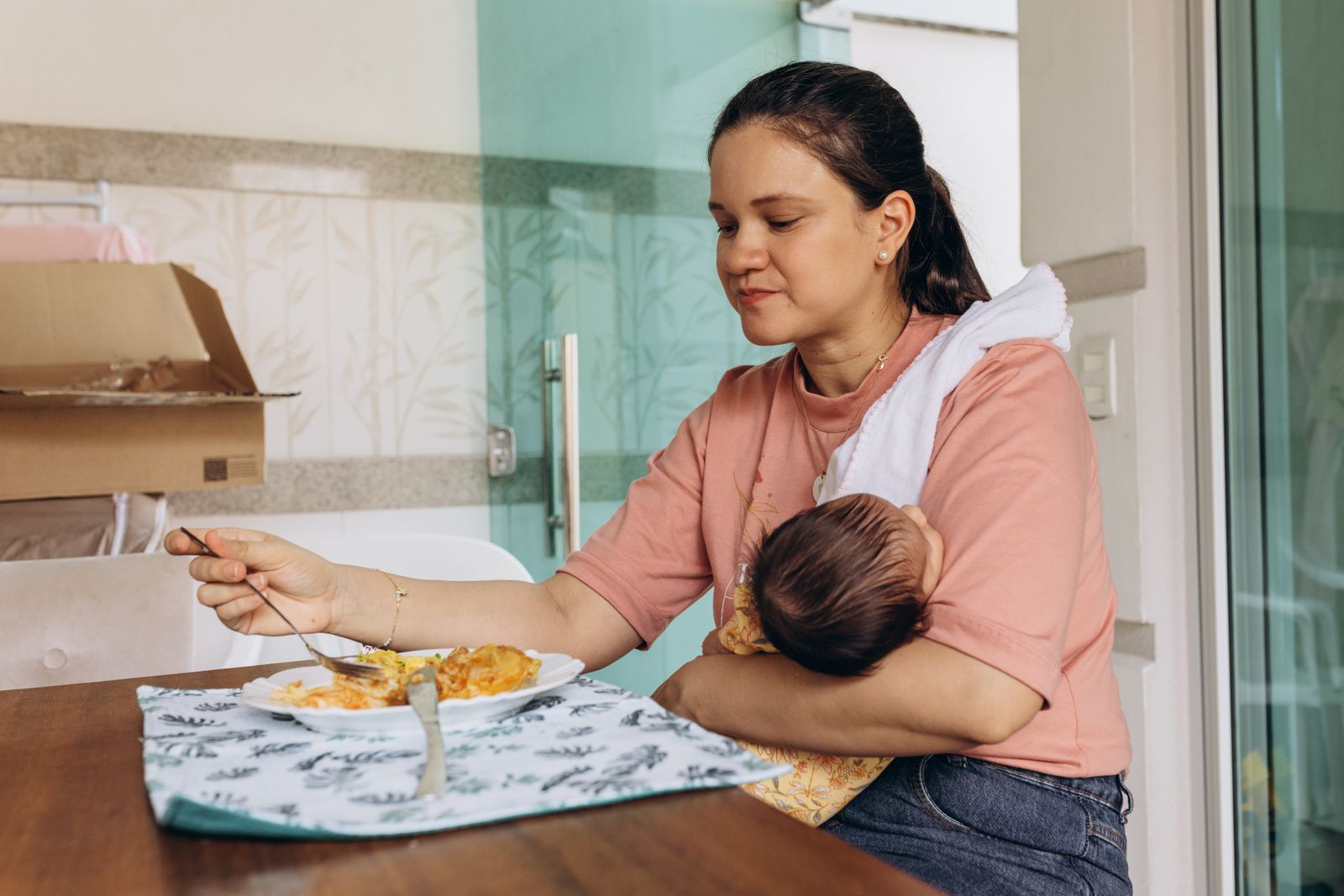
- Set up a feeding station. Keep a water bottle, a napkin, and a snack bowl where you usually nurse, so you are never stuck hungry with a sleeping baby.
- Make lunch a bowl. Rice or a grain, a protein such as beans, tofu, chicken, or canned fish, and a vegetable you can eat with a spoon. Cooked in bulk, it reheats in a minute.
- Add a mid-afternoon snack. Fruit with a handful of unsalted nuts, hummus with bread or vegetable sticks, or cereal with milk are all ideas the NHS lists.
- Plan dinner for the freezer. Soups, stews, and casseroles made in a double batch mean tonight's meal and a spare. The NHS suggests cooking extra and freezing it, and it notes that tinned and frozen vegetables count as well.
- Keep something by the bed. A banana, a cheese stick, or a small bag of trail mix helps with night feeds without a trip to the kitchen.
- A protein at each meal, and a snack that has some too
- Fruit or vegetables most times you eat
- Water within reach of your feeding spot
- Caffeine at a moderate level, and none late in the evening if your baby is unsettled
- Low-mercury fish in the weekly amounts above
- A prenatal or multivitamin, if your provider agrees
- A freezer meal or two for the hardest days
If you want a longer look at the food groups in a general diet, our pregnancy nutrition essentials guide covers many of the same foods. Friends who offer help usually mean it, so say yes to a home-cooked dinner, as the NHS also suggests.
Plant-based diets and cultural postpartum traditions
A vegetarian or vegan diet can work well while breastfeeding, but it needs planning. The CDC notes that babies of mothers who eat no animal products may get very little vitamin B12 from milk, and low B12 can put an infant at risk of neurological damage. Iron may also be a concern, because plant foods have only non-heme iron, which is absorbed less easily. The CDC says providers should work with vegetarian and vegan mothers on supplements that may include B12, iron, vitamin D, zinc, choline, calcium, iodine, and omega-3 fats. The NHS makes the same point about B12 and suggests choosing fortified foods or a supplement. If you eat this way, book a conversation with your provider or a registered dietitian early.
Many families also follow postpartum food traditions, such as the confinement period in Chinese, Korean, and many other cultures, with warm soups, ginger, sesame oil, bone broths, and other nourishing foods. These traditions are meaningful, and in most cases there is no reason to give them up. Warm, soft, protein-rich food is a very good way to eat after birth. The one thing to check is safety. Some tonics and soups are made with rice wine or other alcohol, and some herbal mixes are hard to know the contents of. Ask whoever is cooking what is in the dish, and check with your provider if a herbal product is involved. Choose the alcohol-free version, or the nourishing broth without it, and you can keep the tradition.
A realistic scenario
Picture a mother at six weeks. Her baby is cluster feeding every evening, and for the third day in a row she has had coffee and half a bagel for breakfast and nothing much until her partner gets home. By 7 p.m. she is shaky, headachy, and snapping at everyone. She is not failing. She has simply not eaten enough to match what her body is doing.
She changes small things. On Sunday she cooks a pot of lentil soup and freezes six portions. She puts a bowl of nuts and dried fruit and a water bottle next to the nursing chair. She has one coffee in the morning, and switches the afternoon cup to a herbal tea. Within a week she is eating five times a day, her headaches ease, and the baby is no different. Nothing about her milk changed. Her energy did, and that was the point.
Common mistakes
- Skipping meals because the baby is busy. Eating little makes you tired and cranky, and it is the first thing to fix.
- Cutting dairy or other foods without a reason. Gassiness alone is rarely a sign of allergy. See your pediatrician first.
- Crash dieting early. Very low calorie eating while healing is hard on you, and it may affect supply.
- Pumping and dumping after a drink. It is not needed. Timing the feed is what helps.
- Counting every cup of coffee in a panic. A moderate amount is fine. Watch your baby, not just a number.
- Buying supply boosters before checking the latch. Milk removal drives supply, so check how well the baby is feeding first.
- Forgetting your own vitamins. Ask about continuing your prenatal vitamin, especially if you eat a vegan diet.
Myths vs. facts
Myth: You must eat dairy to make milk. Fact: Milk is made from your body's stores and your intake overall, not from a particular food. Dairy and fortified alternatives help with calcium, but you can get it elsewhere.
Myth: Spicy or gassy foods will upset your baby. Fact: Most babies tolerate them fine. Change your diet only if the baby reacts consistently, and ideally after talking to your pediatrician.
Myth: You need to drink huge amounts of water. Fact: Drink to thirst. Keeping a glass beside you at each feed helps you remember, but forcing fluids is not necessary.
Myth: Breastfeeding burns off the baby weight fast. Fact: It uses energy, but appetite rises too, and many people lose weight gradually. Slow progress is normal.
Myth: One drink means you must dump your milk. Fact: The NHS says you do not need to express to clear alcohol. It leaves your milk as it leaves your body, so timing feeds is the useful step.
When to talk to your provider, a dietitian, or an IBCLC
Eating well after birth is usually simple, but some signs deserve a conversation. Contact your provider if any of these apply:
- Very low appetite for several days, or you cannot keep food down
- Rapid weight loss, or weight dropping without trying
- Feeling sad, anxious, hopeless, or numb, which can affect eating (see our guide to postpartum mood changes)
- Dizziness, fainting, or a racing heartbeat when you stand
- Blood or mucus in your baby's stool, or eczema that is getting worse
- Worry that your baby is not getting enough milk, such as few wet diapers or poor weight gain
- A vegan or restricted diet and no plan for B12, iron, and iodine
- A health condition such as diabetes, a thyroid disorder, or a history of an eating disorder
A registered dietitian can build a plan around food allergies, cultural preferences, or weight concerns. An IBCLC helps with supply, latch, and feeding questions. If you feel hopeless, or you have thoughts of harming yourself or your baby, seek help right away from your provider or emergency services. Food guidance matters, but you matter more.
Frequently asked questions
How many calories do you need while breastfeeding?
The CDC says an extra 330 to 400 calories a day is recommended for well-nourished mothers compared with before pregnancy, but it varies with your age, body mass index, activity, and whether you breastfeed exclusively. Eat to hunger and ask your provider for a personal number.
What foods should you avoid while breastfeeding?
Most mothers do not need to avoid specific foods. Limit high-mercury fish and follow the FDA and EPA fish advice, keep caffeine moderate, and plan alcohol around feeds. Skip foods only if your baby reacts consistently, and talk to your pediatrician first.
How much caffeine is safe while breastfeeding?
The CDC says about 300 milligrams or less a day, roughly two to three cups of coffee, is low to moderate. The NHS recommends no more than 200 milligrams a day. Younger babies clear caffeine more slowly, so the lower end may suit a newborn.
Can I have a drink while breastfeeding?
The NHS says the safest approach is no alcohol, but an occasional drink is unlikely to harm your baby, especially if you wait at least 2 hours before feeding. You do not need to pump and dump. Never sleep with your baby on a bed or sofa after drinking.
Does my diet affect my milk supply?
Not much. Supply depends mostly on how often milk is removed. Very low calorie eating may affect supply and your energy, and heavy drinking may reduce it. Lactation cookies and herbal boosters have limited evidence, so talk to your provider or an IBCLC about supply worries.
Is it safe to lose weight while breastfeeding?
Gradual loss through a balanced diet and moderate exercise is generally fine, and the NHS says it will not affect milk quality or quantity. Avoid crash diets in the early months, and ask your provider what pace suits you.