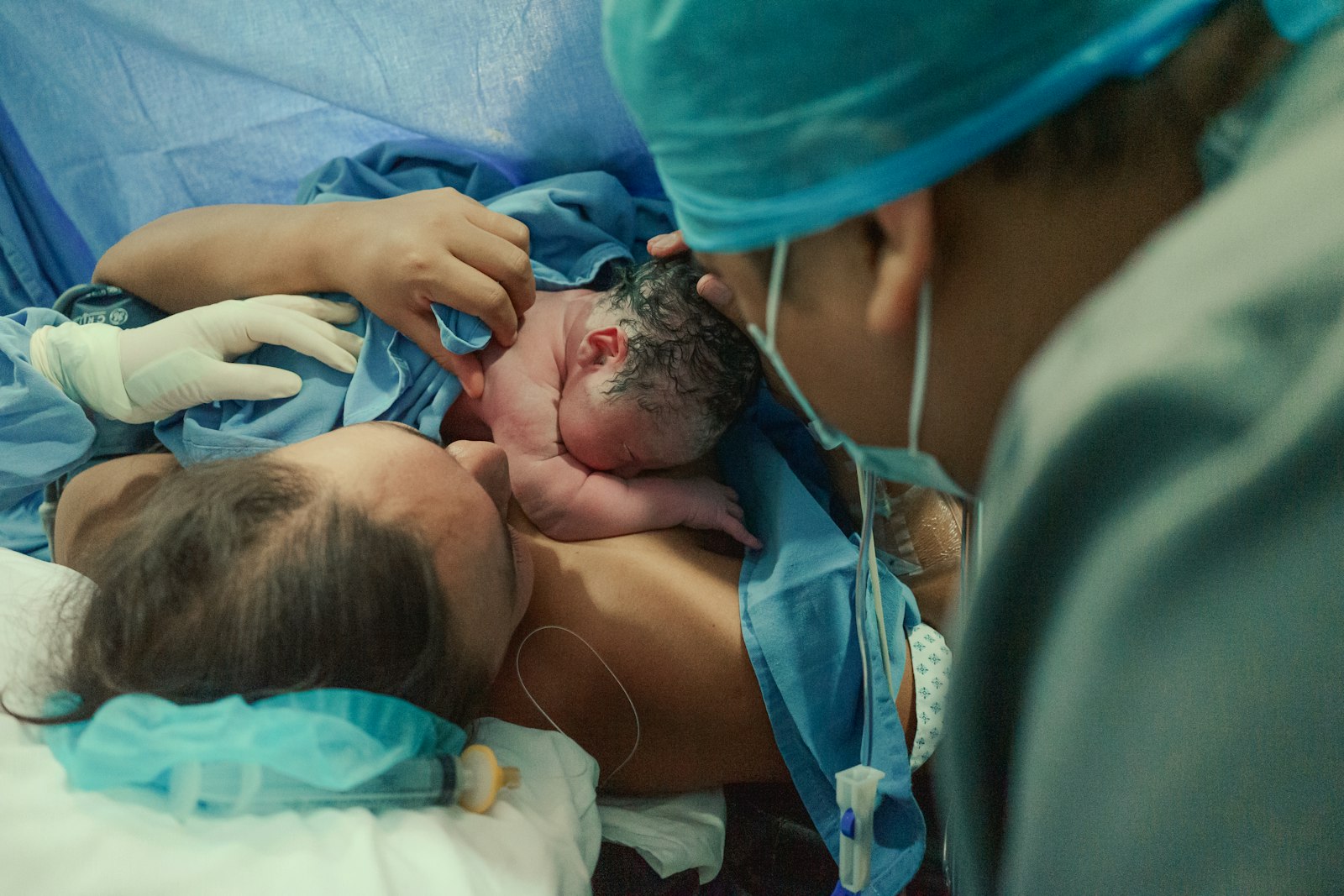
Photo: Unsplash
A birth plan works best as a communication tool with your care team — a clear summary of your preferences — rather than a rigid script for how labor "must" go.
What to actually include
The American College of Obstetricians and Gynecologists offers general guidance on the topics worth thinking through before writing your own plan.
- Preferences for pain management (epidural, unmedicated, open to either).
- Who you want present during labor and delivery.
- Preferences around movement, positioning, and eating/drinking during labor, where allowed.
- Immediate newborn preferences — skin-to-skin, delayed cord clamping, feeding plans.
- Preferences if a C-section becomes necessary.
Pain management: laying out your options
Rather than a single yes-or-no on the epidural, it helps to think through a few scenarios: Do you want to try laboring without medication first, with an epidural available if you change your mind? Are you interested in nitrous oxide, a birthing tub, or a TENS unit if your hospital offers them? Do you have any concerns about needles or a history that would make an epidural more complicated? Writing out your first choice and a backup gives your care team useful information even if labor doesn't unfold the way you expect.
Newborn procedures worth deciding on ahead of time
Several routine newborn procedures happen fast after delivery, so it's worth thinking about them before you're in the room. Common ones include the timing of cord clamping (delayed clamping is now standard at many hospitals but still worth confirming), a vitamin K shot to prevent a rare bleeding disorder, erythromycin eye ointment to prevent infection, and the newborn hearing screening. Some parents also have preferences about circumcision timing, whether visitors are allowed in the first hours, and whether they want to keep or donate the placental cord blood. None of these decisions need to be made alone — your provider can walk through the reasoning behind each one at a prenatal visit.
A doula or support person's role
If you're planning to bring a doula, partner, family member, or friend as a support person, it helps to note their role explicitly in your birth plan — whether that's advocating for your preferences if you're unable to speak up, providing comfort measures like counterpressure or position changes, or simply staying calm and present. Hospitals typically allow one main support person plus additional visitors depending on policy and space, so it's worth confirming ahead of time if you're hoping to have more than one person present.
If a C-section becomes necessary
Even a birth plan built around a vaginal delivery benefits from a short section on C-section preferences, since roughly a third of U.S. births end up being surgical. Preferences worth noting include whether you'd like a clear surgical drape (so you can watch the delivery), immediate skin-to-skin in the operating room if your baby is stable, and who is allowed to stay with you during surgery. Having thought through this in advance — rather than for the first time mid-labor — tends to make an unplanned C-section feel less disorienting.
Postpartum and hospital-stay preferences
A birth plan doesn't have to stop at delivery. Consider noting feeding preferences (breastfeeding, formula, or combination, and whether you want lactation support), whether you want your baby to room-in with you overnight or spend time in the nursery, and any cultural or religious practices you'd like the care team to be aware of, such as specific naming ceremonies or dietary needs. Some parents also note pain management preferences for the postpartum recovery period itself, separate from labor.
Keeping it short enough to actually be used
A birth plan that runs several pages is less likely to be read in full during a busy shift change. Most labor and delivery nurses recommend keeping it to one page, organized with short headers and bullet points rather than paragraphs, so key preferences can be scanned quickly. Bring two or three printed copies — one for your chart, one for the delivery room whiteboard or wall, and a spare — since hospital systems don't always carry documents forward electronically between departments.
Building your plan section by section
A practical way to draft a birth plan is to work through it in the order events actually happen, rather than trying to think of everything at once. Start with labor itself: pain management preferences, who you want present, and movement or positioning preferences. Move to delivery: pushing positions if you have one you prefer, and whether you want a mirror or to be told when the baby is close. Then cover the immediate newborn period: skin-to-skin, delayed cord clamping, and who cuts the cord if that matters to you. Finish with the hospital stay: rooming-in versus nursery time, feeding plans, and visitor preferences. Working through it in this chronological order tends to surface preferences you might otherwise forget to write down.
What your care team wishes more birth plans included
Feedback from labor and delivery nurses often points to the same handful of gaps. Many birth plans skip pain management preferences for the postpartum period specifically, focusing only on labor itself, even though afterpains and incision or perineal discomfort are common in the days after delivery. Plans also frequently leave out preferences around a support person's role if you need an unplanned procedure, and whether you want to be informed of every detail in the moment or would rather your partner or support person filter information for you while you focus on labor. Adding a line or two on these points rounds out a plan considerably without making it much longer.
Why flexibility matters
Labor doesn't always go as planned, and medical circumstances can require deviating from any birth plan. Framing it as "preferences, given a normal, uncomplicated labor" rather than a fixed demand tends to reduce disappointment and friction with your care team.
How to discuss it with your care team
Bring your birth plan to a prenatal visit before your due date, not just the day of delivery — this gives your provider a chance to flag anything unusual or clarify hospital policies ahead of time, rather than during active labor.
Birth plans for a hospital, birth center, or home birth
The core preferences in a birth plan carry over across settings, but a few things shift depending on where you are giving birth. In a hospital, ask about routine policies you may not think to question otherwise, like continuous fetal monitoring versus intermittent monitoring, IV access requirements, and how visitor policies work on the labor and delivery floor. At a birth center, confirm in advance what happens if a transfer to a hospital becomes necessary, since birth centers typically handle low-risk labor only and have a specific transfer protocol worth understanding before labor starts. For a planned home birth, your birth plan should include the same transfer question, plus details like who will be present (a midwife, a doula, family), and what equipment and emergency plan your midwife has in place. Whichever setting you choose, asking your provider to walk through their own protocols, rather than assuming they match what you have read online, avoids surprises later.
Common mistakes when writing a birth plan
- Writing it as a rigid set of demands rather than ranked preferences, which can make it harder for a busy care team to work with during a fast-moving situation.
- Leaving out a C-section section entirely, even though a meaningful share of births end up surgical.
- Making it too long to be read quickly during a shift change, when a one-page summary is far more likely to actually get used.
- Never actually discussing it with your provider before labor, so preferences come as a surprise on delivery day.
- Treating an unmedicated birth or a specific outcome as the only version of a "successful" birth, which can add unnecessary guilt if circumstances change.
Common myths about birth plans
A few misconceptions come up often enough to be worth addressing directly. A birth plan is not a legal document your hospital is obligated to follow exactly, and treating it that way sets up unrealistic expectations. Having a detailed birth plan does not mean you are being "difficult" or high-maintenance. Most labor and delivery staff appreciate knowing preferences clearly, since it actually saves time compared to figuring out preferences in the moment. And a birth plan is not only for people planning an unmedicated, low-intervention birth. Parents planning a scheduled C-section, an induction, or an epidural from the start benefit just as much from writing down their preferences for the parts of the experience they do have some say over.
A real-life scenario: when plans change mid-labor
Consider a parent whose birth plan requests an unmedicated labor with intermittent monitoring, who then develops a complication partway through labor that requires continuous monitoring and, eventually, a C-section. A well-written birth plan anticipates this by including preferences for exactly this scenario, like wanting a clear drape and immediate skin-to-skin in the operating room if the baby is stable. Because those preferences were already written down and discussed at a prenatal visit, the care team can honor as much of the original plan as medically possible, even though the overall path of labor looked nothing like what was originally hoped for. This is the practical value of thinking through "what if" scenarios ahead of time, rather than only planning for the outcome you expect.
Updating your plan as your pregnancy progresses
A birth plan you draft at 28 weeks does not have to be your final version. As you get closer to your due date, take a fresh look at it in light of anything new: a change in your provider's practice policies, a new diagnosis like gestational diabetes that might affect your options, or simply a change of mind after talking with other parents or your care team. Treating it as a living document you revisit once or twice more before delivery, rather than a one-time task to check off early in pregnancy, keeps it accurate and genuinely useful when labor actually starts.
Questions worth asking your provider before writing your plan
A short conversation at a prenatal visit can save a lot of guesswork. Useful questions include: what pain management options does this specific hospital or birth center offer, and which ones need to be requested early rather than in the moment; what is the hospital's policy on delayed cord clamping and skin-to-skin after both vaginal and C-section deliveries; how many support people are allowed in the room, and does that change for a C-section; and what happens if you go past your due date or need an induction. Getting specific answers, rather than general assumptions from articles or other parents' experiences, means your birth plan reflects what is actually possible at your specific hospital or birth center.
Frequently asked questions
Does every hospital honor a birth plan exactly?
Most hospitals try to accommodate reasonable preferences, but medical necessity always takes priority, and specific hospital policies vary. Discussing your plan in advance helps set realistic expectations.
Do I need a formal document, or can I just talk to my provider?
Either works — some people prefer a written one-page summary for the labor and delivery team, while others rely on ongoing conversations with their provider. Do whatever helps you feel prepared and heard.
Do I need a different birth plan for a home birth or birth center?
The core preferences carry over, but you should also include a transfer plan in case a hospital transfer becomes necessary, along with who will be present and what emergency equipment your midwife or birth center has on hand.
Should I write a birth plan if I'm having a scheduled C-section?
Yes. You can still note preferences like a clear surgical drape, immediate skin-to-skin if your baby is stable, who is allowed in the operating room, and feeding and postpartum preferences.